

Do You Know All About The Types Of Roof Tiles?
Apr 01, 2023
Leave a message
The birth of each type of tile has its own story. Traditional ceramic tiles and glazed tiles carry the charm of ancient architecture and have a long history. Modern colored stone tiles and resin tiles showcase the achievements of development, allowing people to gradually see the colorful fun of roof tiles in modern life. So in the dazzling tile market, what kind of roof tiles are effective and what type of roof tiles can meet everyone's needs? Today, we will briefly introduce several different types of roof tiles based on their different materials.
Glazed tile
Flowing and colorful glazed tiles are traditional Chinese architectural objects made from ore raw materials, screened and crushed, high-pressure formed, and high-temperature fired. Widely applicable to industrial and civil buildings such as factories, residences, hotels, villas, etc.
Its advantages include high strength, good waterproof performance, and high glossiness.
Disadvantages: Relatively heavy, high transportation cost, fragile, and prone to detachment due to poor laying and hanging techniques.
Earthenware tile
Ceramic tiles are made from clay and other synthetic materials by drying wet embryos and firing them at high temperatures. It is a rooftop product with a thousand year history of Chinese culture. The production process is simple, and local materials can be obtained from various parts of the country, accounting for the vast majority of sloping roofs in the past. But with the increasing protection of land resources by the country year by year, some pottery and clay building materials have begun to be restricted in some cities.
Advantages: Long service life, long history, inheritance for thousands of years, strong load-bearing capacity, and wide application.
Disadvantages: It is relatively heavy, prone to detachment, damage, moss growth, and environmental damage during production. The country does not advocate it and gradually withdraws from the market.
Color steel tile
Colored steel tiles, also known as colored profiled tiles, are made of colored coated steel plates that are rolled and cold-formed into various wave shapes. They are suitable for the roofs of industrial and civil buildings, warehouses, special buildings, and large-span steel structure buildings.
Advantages: Multiple color styles, light weight, fast construction, flexible and convenient installation, and low cost.
Disadvantages: Short service life, easy to corrode, noisy, non fireproof, windproof, high risk factor, and requiring regular maintenance.
Asphalt shingles
Asphalt shingles are tile shaped roof sheets made from fiberglass felt as a matrix, soaked in petroleum asphalt, covered with colored mineral particles on one side, and spread with insulating materials on the other side.
Advantages: The laying effect is geometric, with a beautiful appearance, sound insulation and noise reduction, diverse colors, dustproof and self-cleaning, and corrosion resistance.
Disadvantages: Not resistant to ultraviolet radiation, easy to age, short service life, poor firmness, easy to fall off, poor flame retardancy, avoiding contact with open flames, inconvenient installation, necessary waterproof rolls for secondary waterproofing during laying.
Resin tile
Resin tiles are tiles made from resin as the raw material, which can be divided into two categories: natural resin tiles and synthetic resin tiles. Currently, the so-called resin tiles in the market are generally synthetic resin tiles.
Advantages: lightweight, self-cleaning, insulation, easy installation, corrosion resistance, etc.
Disadvantages: Low manufacturing threshold, easy fading and aging, poor weather resistance, easy cracking, high maintenance cost, and difficulty in refurbishment and secondary utilization.
Colored stone tile
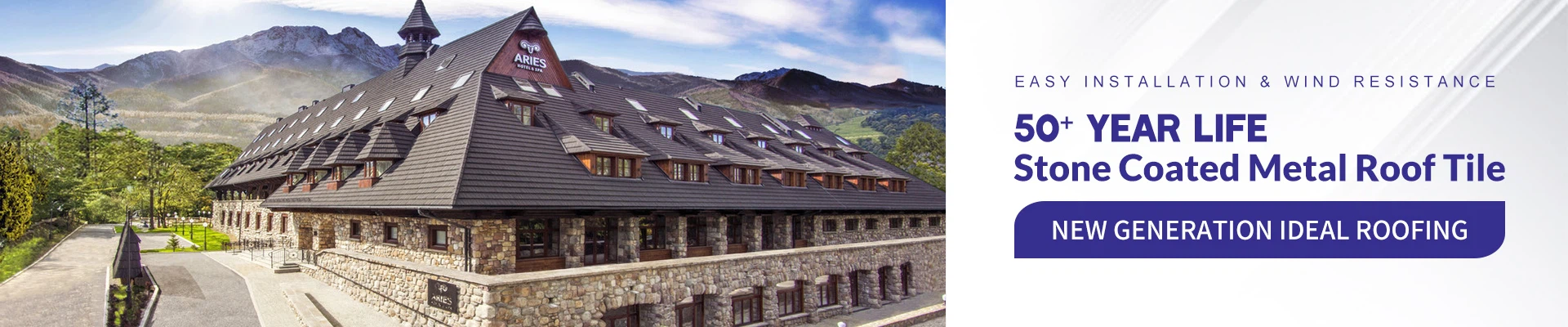
Colored stone tiles are a new advanced roofing material that uses aluminum zinc plated steel plates with excellent anti-corrosion performance as the substrate, water-based acrylic ester as the adhesive, sintered colored sand as the surface layer, and acrylic resin with strong weather resistance as the outermost layer.
Advantages: With a lifespan of up to 30 years, it is environmentally friendly, lightweight, and has strong weather resistance. It is not afraid of extreme weather, and is heat-resistant, low-temperature resistant, flame retardant, waterproof, corrosion-resistant, soundproof, and noise proof. It is widely used and can be reused after renovation.
Disadvantages: The cognitive scope is not wide, the manufacturers of colored stone tiles are mixed, and many small manufacturers substitute inferior products, disrupting the market.
The above is a brief introduction to some common tile types on the market, and you can choose the suitable roofing materials for different buildings. Because they all have different characteristics, the scope of use is also different. If it is a self built house, then we recommend colored stone tiles because they are a new type of roofing material, and their appearance and service life are superior to traditional tiles. However, regardless of the type of tile, it is necessary to choose products from reputable manufacturers and install them strictly in accordance with standard requirements, in order to ensure its quality and achieve perfect decoration effects without leaving any regrets.